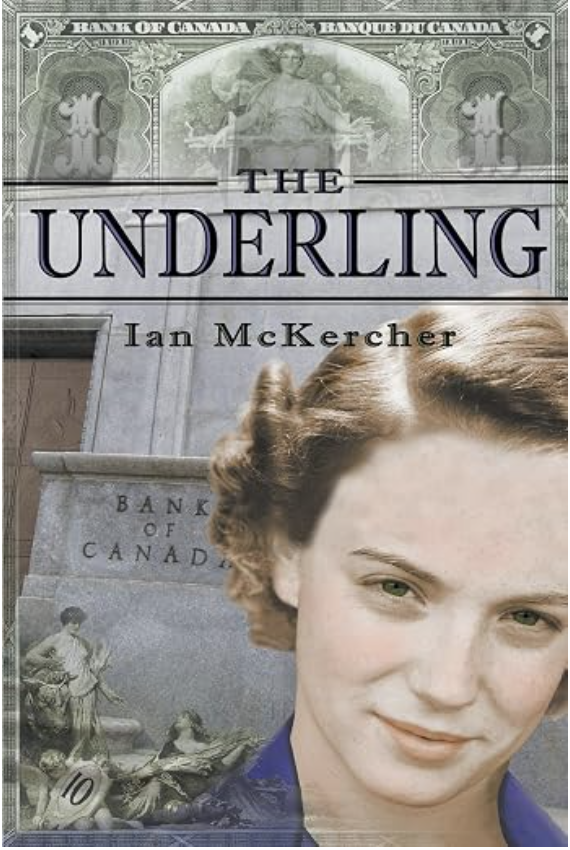
The Underling by Ian McKercher
Book 1/5 of The Frances McFadden Mysteries
2012, 372 pages, Ian McKercher, $25
Historical Fiction, Homefront WW2
This was a fun read. It’s light-hearted, fast-moving, and heart-warming, but not a cast-of-thousands existential descent into the human heart. I’d read this book when it was first released in 2012, and re-read it in 2026.
The story follows a young woman named Frances McFadden over five years as she gets hired out of a high school typing class and dropped into the primal birthing waters of the nascent Bank of Canada. She meets important people along the way, history happens around her, and she charms the great and the good of pre-War Ottawa. While most of the book is a series of slices-of-life for McFadden and her charmed life, the last five or six chapters deals with a daring escape from the clutches of the Germans as World War Two is about to take off in the unpredictable summer of 1939.
This story did a really good job of making the city of Ottawa a part of the story. McKercher is a long term resident of Ottawa, and knowledgeable of the geography and history of the area, and this really helped to make the city feel lived in, and not just a substitute for any other North American city. One of the other slice-of-life aspects of the book is that characters come in, have an impact, and then leave without returning. They have their entrances and their exits, which are not always grandiose. This is very much like life and I appreciated this realism in the storytelling. A character like a Chinese gangster, or a bank manager, or a bridge partner may be important for a few chapters and then forgotten. I really liked that in terms of making the world seem lived in.
The weak point of the story was that the plot involved a plucky girl who hadn’t finished high school, but through her tenacity and go-get-‘em attitude, she side-steps all old-boy networks, issues of class, of race, of gender are swept aside. This is a WASP fantasy that there was, at least in the 1930s, a meritocracy in Canada. In literary terms, she’s a Mary Sue.
That being said, I really enjoyed the book. I’m happy to give it five stars, despite the lack of a well-rounded protagonist. The point of the book is Bildungsroman, a foundation story, not just for the main character, and the current quintet of books, but also for the institution of the Bank of Canada. It’s self-published and not high literature, but it doesn’t purport to be. It presents itself as a light read, following a character through 1930s Ottawa and hits its target with marked success. The problems do not inhibit readability or enjoyment. I’d recommend this to anyone.
★★★★☆