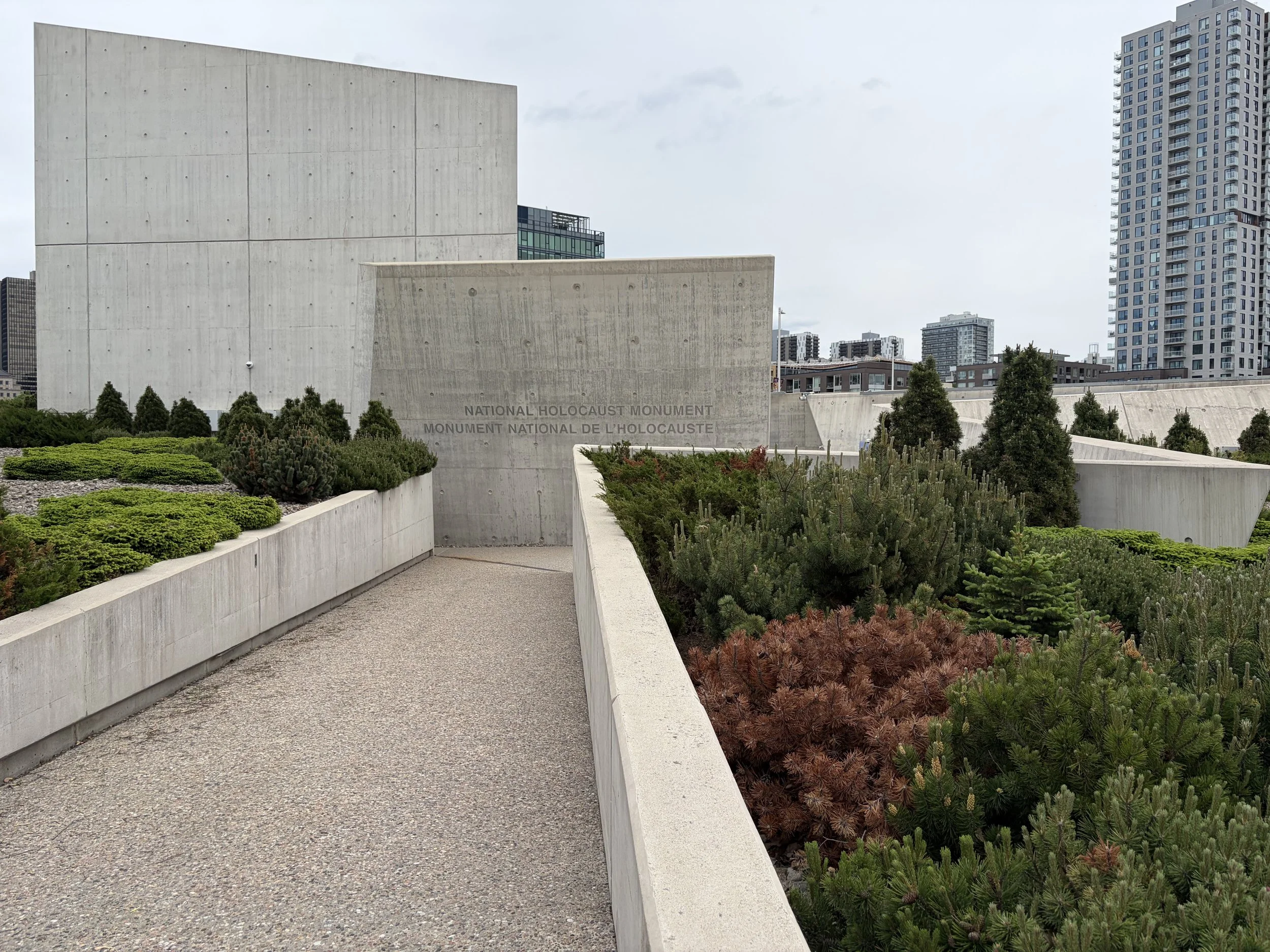
National Holocaust Monument (https://www.holocaustmonument.ca/)
1918 Chaudière Crossing, Free
I went to this as a part of a guided tour by the Centre for Holocaust Education and Scholarship (CHES), as a member of the Historical Society of Ottawa (HSO). While I had the benefit of two guides from CHES who were both knowledgeable and experienced, the generally available guide for anyone wanting to do this tour is virtual, so download the IWALK app to provide context for the materials that you’ll be looking at, if you plan to visit here without the benefit of experienced in-person guides. The app is not well-designed, and you have to first download the IWalk app, and then the Holocaust Memorial material within the app itself.
The monument was something that I had no interest in visiting before the HSO organized the tour, because of the pictures I’d seen, and driving past it, the stark, brutalist structure had no appeal to me, aesthetically speaking. From the inside, it was something else entirely. All of the angles are acute or obtuse, even the ground surface is slanted, giving the monument an almost Lovecraftian geometry-out-of-space feel to it. This, combined with the way the space is controlled on all sides by giant walls creates an isolated cement grove, where even the automotive traffic outside, and the foot traffic from the nearby Asian Street Food festival were kept at bay. This was a separate space from the rest of the city, where things seemed simply wrong – a metaphor for the Holocaust as a negation of civilization in the heartland of modernity. The structure was significantly more powerful than I’d thought it would be.
The public art was also something that really stood out to me. Photorealistic representations were dyed or burnt into the stark concrete, to show the train tracks to Treblinka, or the barbed wire at Auschwitz. These images were not attractions, or embellishments, but were simply a part of the concrete superstructure.
This is a monument, not a museum, and it assumes that a visitor knows about the Holocaust, so learning and teaching is not the raison d’etre of this space. The app gives context to the meaning of the historical events, as well as some of the historical background of the events in Europe and Canada’s reaction.
Something that I appreciated about this monument, aside from the physical use of space, was how the balance of historiography was handled. While the focus was on the Jewish experience, there was also shared space to note the suffering of Gypsies, the mentally infirm and socialists.
Exploring the monument through the tour app took me about an hour, and it was an hour well-spent.